
-
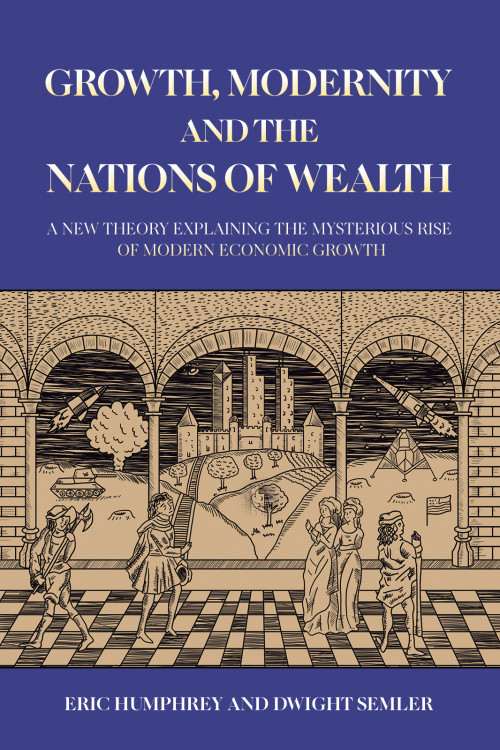
Growth, Modernity and the Nations of Wealth
Eric Humphrey and Dwight Semler present a new theory explaining the mysterious historical emergence of modern economic growth and its even more baffling offspring, modernity. Noticeable changes in material life began less than three centuries ago, but previous theoretical accounts have failed to explain their arrival. Thinkers assumed modern wealth and morality were the universal standard driving human history. They assumed modern rights and riches were natural and normal. In this way they thought of such things as ends rooted in human nature, rather than deriving them as consequences from a historical, nonmodern baseline. Misdirected, they set out to liberate the imprisoned modern homunculus who “caused modernity” through moral education and economic institutions. Modernity became an “awareness problem.” Yet this high-maintenance modern self and its ever-growing needs are a consequence of modern processes rather than their cause. Consequently, theorists of the modern world produced comically omnipotent notions of human agency. Marxists and developmental economists saw modernity as a moral or material self-realization project, requiring only a liberator or engineer. But when their God-of-Genesis model failed the facts, they overreacted and defaulted to its alter ego—humans were passive leaves in the wind of history. Modernity thus oscillates between a chosen destiny and a given fate. With modernity represented as a historical fate, all pretense of a grand theoretical view vanishes in thick description of one damn thing after another, and the historian’s rote chronology replaces any theoretical causality, as a specific description of a particular falling rock replaces a general theory of gravity.
Understanding the modern world and how it came to be, argue the authors, is less a matter of facts than of the foundational assumptions used to link facts together into robust and coherent theories. We must un-assume our modern selves and give poverty and illiberality their just historical due. With better and more scientifically consistent assumptions, they argue, the old facts of history can be seen in a new way. Then the solution to understanding the most puzzling and abnormal of human events, the modern world itself, turns out to be hiding in plain sight.
$41.95 -
Thoughts Expressed Through the Written Word
This literary work is the product of my personal activity in the effort of lifelong self-expression. Self-expression can be accomplished through a number of manners, including all forms of art, music and performance. My form of expression is through the written word. As I experience the varied performance arts of others, I appreciate the message and communication of the artist and ultimately experience self-growth. Some individuals are driven to self-identify and as Dale Carnegie stated, “Self-expression is the dominant necessity of human nature.” I started writing when I was twelve years old.
This work expresses the intellectual, emotional, and personal growth I have experienced over a period of fifty-five years. As stated by Oprah Winfrey, “If we’re really committed to growth, we never stop discovering new dimensions of self and self-expression”. My two previous literary works, Grinnin’ Like a Jenny Eatin’ Saw Briars and Let Me Tell You a Story, published by Austin Macauley involve the communication of events and experiences in my life. As stated by Pearl S. Buck, “Self-expression must pass into communication for its fulfilment”. For this reason, I have chosen to fulfil my literary work through the writing and publication of this book.
$37.95 -
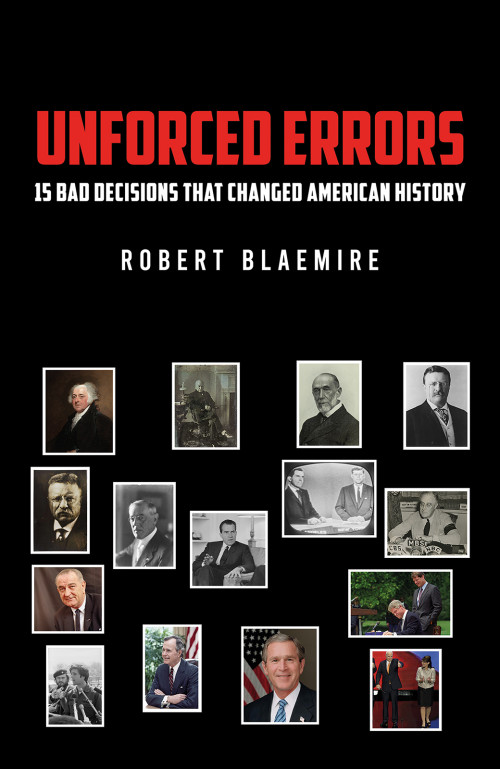
Unforced Errors: 15 Bad Decisions That Changed American History
Americans often use terms such as “To err is human,” or “nobody’s perfect,” or “we all make mistakes.” Of course, this is true, as it is for all of America’s leaders through the years.
This book is about decisions made in politics or public policy that may be considered unwise; bad decisions that had unintended negative consequences for the decision-maker. This will not include personal decisions like deciding who to marry or whether to get divorced but rather to look at those political and policy decisions that can be considered, at the very least, unwise. Similarly, Kennedy’s decision to visit Dallas in November 1963 led to his death but doesn’t really qualify as a decision of real political or policy calculation. Lincoln going to Ford’s theatre would be in that same category.
Instead, Unforced Errors lists 15 political calculations made by political figures, often at the pinnacle of their own success, which changed American history.
$29.95 -

Tears of Love
Everybody wants freedom. Every nation seeks it. Every organization demands it. The press, too, fights for its freedom. From the Garden of Eden to the present day, the quest for freedom has continued unabated. Yet, no one has ever truly defined what freedom is, making it a deeply subjective concept.
The British press is one of the freest and most powerful in the world, but its perception of freedom is its own. When press freedom collides with the idea of perceived press freedom in an era of political correctness, the consequences are profound. This book delves into that very collision, exploring its impact on society and media integrity.
A must-read for anyone interested in the power of the press, this book reveals how the British media shapes, influences, and even alters public perception.
In today’s world, information is everything. The speed at which it flows has transformed the world into a global village. But what happens when that flow is controlled, manipulated, or misunderstood? This book seeks to answer that question.
$36.95 -

Tulip for Tebeau
Pioneers and their schools have long had a mutually beneficial bond. This symbiosis was eloquently articulated by a Duke University resident, Broadbent, at the dedication ceremony for the Samuel DuBose Cook Center for Social Equity: “You have led a remarkable life and we are today annexing your name to the fame of this school. Some might say we are honoring you by naming the Center after you, but everyone knows the truth - we are honoring ourselves and this Center by appropriating your enduring legacy.”
Cook, a distinguished political scientist, made history in 1966 as the first Black professor to receive tenure at a predominantly White southern university in the United States. By affiliating themselves with his pioneering work, schools like Duke aim to share in the honor and social capital of civil rights icons. Yet as Broadbent suggests, the true beneficiaries of such naming opportunities are arguably the institutions themselves.
$31.95 -
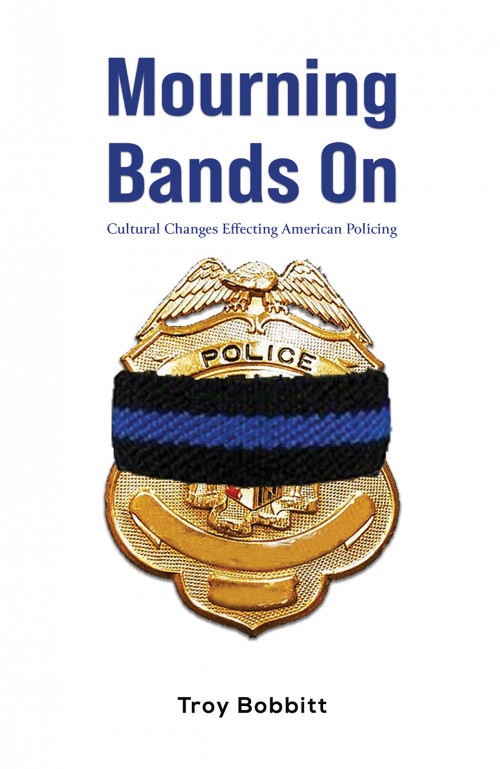
Mourning Bands On
Mourning Bands On is an accessible journey into the hypersensitive world of today’s American law enforcement. The reader is brought into the law enforcement world through an introduction to the history, function, and development of the American police model. With an understanding of policing’s role in American society, the reader is then immersed into the raucous and contentious cultural upheaval which American policing is currently experiencing.
Using well-known examples, the reader is challenged to consider how American culture is affected by critical incidents and the portrayal of those events in our media intensive world. The reader will review the cases in the deaths of Trayvon Martin, Michael Brown, Breonna Taylor, and George Floyd, as well as others. The cases are presented as a narrative of events supported by the findings and legal conclusions of the U.S. Department of Justice, Federal Bureau of Investigation. Each incident is reviewed with a view of how the incident effected American society and brought change to American culture and thus policing.
The reader will experience how American policing has changed through legislative, societal, and cultural pressure resulting from the reviewed critical incidents. With an appetite for more, the reader is encouraged to further explore the relationship between societal norms and American policing.
The work concludes with a final challenge to the reader. How do we, as a society, reform American policing to move forward after this unprecedented period of cultural change? The author offers several possible reforms to enact, what can you add to the conversation?
$27.95 -
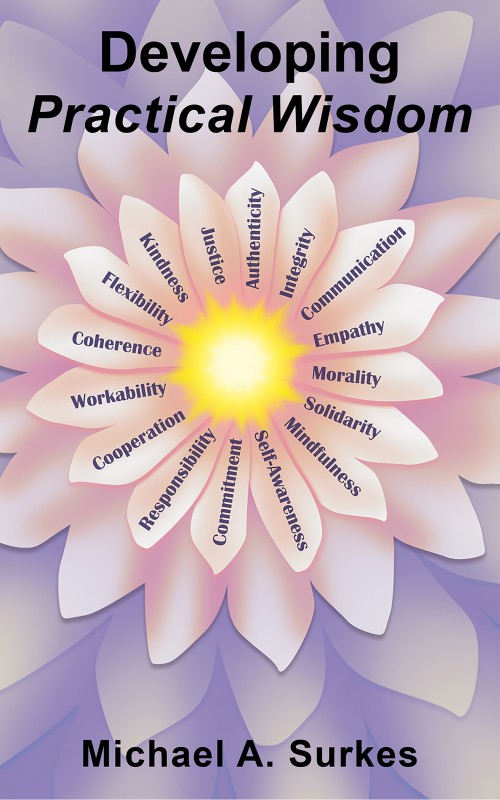
Developing Practical Wisdom
Many people recognize wisdom as an important ideal, but the subject is rarely studied in public education or widely understood outside academia. Drawing from historical and contemporary research in psychology, philosophy, and education, Developing Practical Wisdom describes, in language accessible to any thoughtful reader, how people can intentionally learn to become wiser. The narrative provides a comprehensive set of pedagogical tools, including theories and practices, for developing deeply coherent perspectives on the world and the people in it. It explains how to cultivate coherent thinking and apply moral principles in daily life.
$28.95 -
Actualitas: Philosophy-Art for the 21st Century
Philosophy offers more than a momentary diversion; it provides valuable insights for gaining personal control and making important decisions. Imagine a lone leaf drifting in an autumn breeze, coasting on an updraft before floating to the ground, eventually broken down by the elements and recirculated into the soil. Embracing personal responsibility without scapegoats exemplifies the essence of carpe diem – seize the day.
Throughout history, philosophy has grappled with the concept of fear, though modern times have seen this domain largely conceded to pseudosciences, often offering solutions through natural and synthetic drugs.
Aristotle had much to say about fear: ‘…the things we fear are fearful and such things are, broadly speaking, evils: e.g. disgrace, poverty, sickness, friendlessness, death… Probably one ought not to fear poverty or disease, nor in general anything that is not… one’s own fault…’
$48.95
 Discover
We use cookies on this site to enhance your user experience and for marketing purposes.
By clicking any link on this page you are giving your consent for us to set cookies